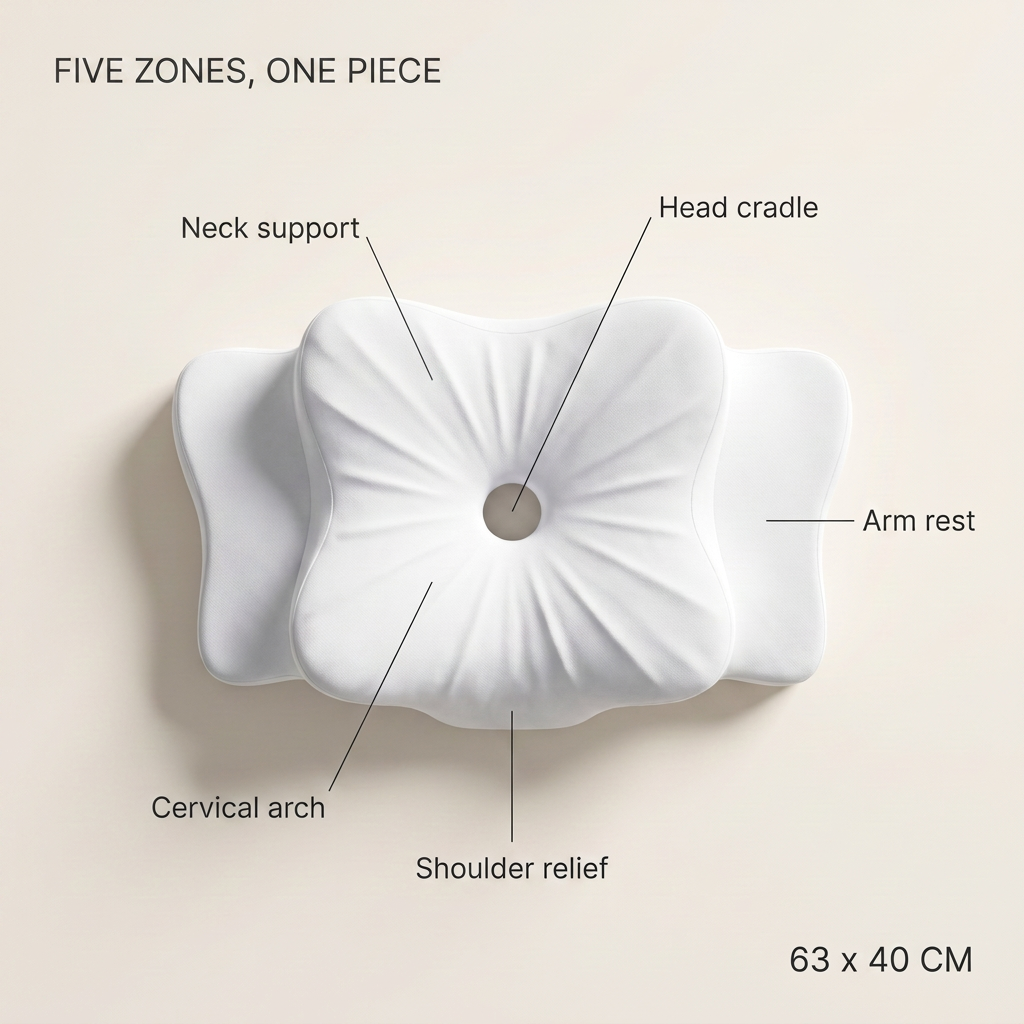
Zoned memory foam moulded around the curve of your neck. Two working heights in one piece — 11 cm on your side, 9 cm on your back.
€99,00€149,00SAVE €50
Two working heights — 11 cm on your side, 9 cm on your back
Five moulded zones: head cradle, neck support, cervical arch, shoulder relief, arm rests
60D memory foam — back to shape in seconds, not in an hour
Removable cover, cut to the contour, machine washable
Contour cover included
Every Loft ships with its washable cover, cut to the shape of the foam.
Secure checkout
SELVELL Loft
€99,00€149,00In stock
Free worldwide shipping
Washable coverCut to the contour
Secure checkout
Five moulded zones
Verified buyers
What comes back to us.
4.8
based on 1,247 verified buyers
Verified
The gap is gone
I have a long neck and every flat pillow left a hollow I could put my hand into. The raised front edge fills it exactly. Second week in and I have stopped waking up to rearrange things.
RH
Rhys H. · Bristol, UK
Verified
Two heights, one pillow
Side most nights, back when my shoulder is sore. Flipping to the 9 cm edge instead of owning two pillows is the part I did not see coming.
IM
Ines M. · Lisbon, PT
Verified
Give it the week
First three nights felt odd — it holds your head still and you notice. By the sixth I had forgotten about it. They tell you this before you buy, which is why I stayed with it.
TK
Tomas K. · Prague, CZ
Verified
The shoulder notch is real
Side sleeper, bad shoulder. The cut-out means my arm goes under the pillow instead of being pinned by it. Nobody else seems to design for that.
NA
Nadia A. · Rotterdam, NL
Verified
Still the same shape at 6am
The 60D foam does what the page says. It gives under my head and it is back by the time the bed is made. My last one stayed dented for an hour.
OB
Owen B. · Portland, US
Verified
Warm, and they said so
It holds more heat than the down one it replaced. The site says that plainly, so I can hardly complain. The knit cover helps and I sleep with a window open anyway.
FS
Frida S. · Malmo, SE
Verified
The cover actually washes
Unzips, machine, done. Cut to the contour so it does not ruck up. Small thing, but it is why this one outlasts the last three.
DM
Diego M. · Valencia, ES
Verified
Mornings feel different
I am not claiming it fixed anything. I am saying the tightness I had every morning for two years is not there. That is enough.
YT
Yuki T. · Osaka, JP
Verified
Ordered a second
Bought one to try. My partner kept taking it, so now there are two. The lowered wings at the sides are the detail that sold it.
CL
Clara L. · Vienna, AT
Verified
Firmer than expected
Properly made, clearly designed rather than moulded at random. Firmer than what I came from — comfortable now, but I would call it supportive rather than soft.
AR
Andre R. · Sao Paulo, BR
Verified
Sensible on the bed
63 by 40 does not take over. The contour cover beats forcing a standard case over the shape.
MB
Maya B. · Toronto, CA
Verified
It matched the description
I bought it partly because the site told me what it does not do. The pillow is exactly what was written. Rarer than it should be.
JV
Jonas V. · Copenhagen, DK
Verified
The gap is gone
I have a long neck and every flat pillow left a hollow I could put my hand into. The raised front edge fills it exactly. Second week in and I have stopped waking up to rearrange things.
RH
Rhys H. · Bristol, UK
Verified
Two heights, one pillow
Side most nights, back when my shoulder is sore. Flipping to the 9 cm edge instead of owning two pillows is the part I did not see coming.
IM
Ines M. · Lisbon, PT
Verified
Give it the week
First three nights felt odd — it holds your head still and you notice. By the sixth I had forgotten about it. They tell you this before you buy, which is why I stayed with it.
TK
Tomas K. · Prague, CZ
Verified
The shoulder notch is real
Side sleeper, bad shoulder. The cut-out means my arm goes under the pillow instead of being pinned by it. Nobody else seems to design for that.
NA
Nadia A. · Rotterdam, NL
Verified
Still the same shape at 6am
The 60D foam does what the page says. It gives under my head and it is back by the time the bed is made. My last one stayed dented for an hour.
OB
Owen B. · Portland, US
Verified
Warm, and they said so
It holds more heat than the down one it replaced. The site says that plainly, so I can hardly complain. The knit cover helps and I sleep with a window open anyway.
FS
Frida S. · Malmo, SE
Verified
The cover actually washes
Unzips, machine, done. Cut to the contour so it does not ruck up. Small thing, but it is why this one outlasts the last three.
DM
Diego M. · Valencia, ES
Verified
Mornings feel different
I am not claiming it fixed anything. I am saying the tightness I had every morning for two years is not there. That is enough.
YT
Yuki T. · Osaka, JP
Verified
Ordered a second
Bought one to try. My partner kept taking it, so now there are two. The lowered wings at the sides are the detail that sold it.
CL
Clara L. · Vienna, AT
Verified
Firmer than expected
Properly made, clearly designed rather than moulded at random. Firmer than what I came from — comfortable now, but I would call it supportive rather than soft.
AR
Andre R. · Sao Paulo, BR
Verified
Sensible on the bed
63 by 40 does not take over. The contour cover beats forcing a standard case over the shape.
MB
Maya B. · Toronto, CA
Verified
It matched the description
I bought it partly because the site told me what it does not do. The pillow is exactly what was written. Rarer than it should be.
JV
Jonas V. · Copenhagen, DK
The shape
Five zones, one moulding.
Most pillows are a single flat block that asks your neck to adapt to them. This one is moulded into five areas, each doing a different job depending on how you lie down.
Measurements are nominal, taken from the moulded foam core. Memory foam is a soft material — small variations between units are normal.
Side by side
A flat pillow, and this one.
The difference is not the material. Both are foam. The difference is that one of them has been given a shape.
A flat pillow
·One height, everywhere
·Your neck bridges the gap unaided
·Shoulder carries the same thickness as your head
·Nowhere for your arm to go
SELVELL Loft
✓Two working heights — 11 cm and 9 cm
✓Raised arch moulded to fill the gap at your neck
✓Cut-out along the front edge for your shoulder
✓Lowered wings for the arm you fold underneath
Questions
Answered plainly.
A normal pillow is one flat block, the same height at every point. This one is moulded into five areas — a recess for your head, a band that supports your neck, a raised arch for the curve behind it, a cut-out for your shoulder and lowered wings for your arm — and it offers two working heights depending on which edge you use.
The taller edge, 11 cm, when you sleep on your side: it fills the wider distance between your shoulder and your ear. The shorter edge, 9 cm, when you sleep on your back. Most people settle on one within the first week.
Probably. A contoured pillow holds your head in one position, and after years on something flat you notice that for a few nights. Give it a week before you decide.
Unzip the cover and machine wash it. Do not wash the foam core — memory foam holds water and will not dry through. Wipe it with a damp cloth and mild soap if it needs it, and let it air dry completely before use.
Memory foam holds more heat than down or feather. The cover is a breathable knit and it helps, but if you sleep very warm this is worth knowing before you order rather than after.
Memory foam softens over time. Expect two to three years of proper support with normal use, and replace it once it stops springing back.
63 × 40 cm, with the profile stepping between 11 cm and 9 cm. It fits a standard pillowcase loosely, but the cover that comes with it is cut to the contour.